The Short Answer:
For most Oklahoma homes, a heat pump is the more energy-efficient choice over the full life of the system, particularly when replacing both the AC and furnace at the same time. Heat pumps can save Oklahoma homeowners 20 to 40 percent on energy costs compared to gas furnaces, according to regional HVAC research, because Oklahoma’s average winter temperatures of 25 to 45 degrees Fahrenheit fall squarely within the range where heat pumps operate at high efficiency.
That said, the right answer depends on your home’s existing infrastructure, natural gas access, budget, and how severe your local winters get. Oklahoma’s climate sits in a genuine sweet spot where both systems work well, and a dual-fuel hybrid system pairing a heat pump with a gas furnace backup is often the optimal configuration for homeowners who want the best of both.
The heating system decision has become more complex and more consequential for Oklahoma homeowners over the past several years. The rise of modern cold-climate heat pumps, updated federal efficiency standards, new Inflation Reduction Act tax incentives, and shifting natural gas prices have changed the math significantly compared to even five years ago.
At the same time, Oklahoma’s climate presents genuinely unique considerations. The state is not the Deep South, where heat pumps have historically dominated. Nor is it the northern plains, where extreme winter temperatures have traditionally made gas furnaces the clear default.
Market Stat:
The Air-Conditioning, Heating, and Refrigeration Institute reported that heat pump sales outpaced gas furnace sales by more than 26 percent from July 2024 to July 2025, reflecting a nationwide shift driven by efficiency improvements, Inflation Reduction Act tax incentives, and rising natural gas prices. Oklahoma homeowners are increasingly part of this trend.
Table of Contents
- How a Gas Furnace Works
- How a Heat Pump Works
- Oklahoma’s Climate and Why It Matters for This Decision
- Upfront Cost Comparison: What Each System Costs to Install in Oklahoma
- Operating Cost: Which System Costs Less to Run in Oklahoma?
- Side-by-Side Comparison: Heat Pump vs. Gas Furnace for Oklahoma Homes
- The Dual-Fuel Option: Often the Best Choice for Oklahoma Homes
- When a Heat Pump Is the Right Choice for Your Oklahoma Home
- When a Gas Furnace Is the Right Choice for Your Oklahoma Home
- Lifespan, Maintenance, and What to Expect Over Time
- Comfort Differences: What Each System Feels Like Day to Day
- Questions to Ask Your HVAC Contractor Before Deciding
- Final Thoughts: Making the Right Decision for Your Oklahoma Home
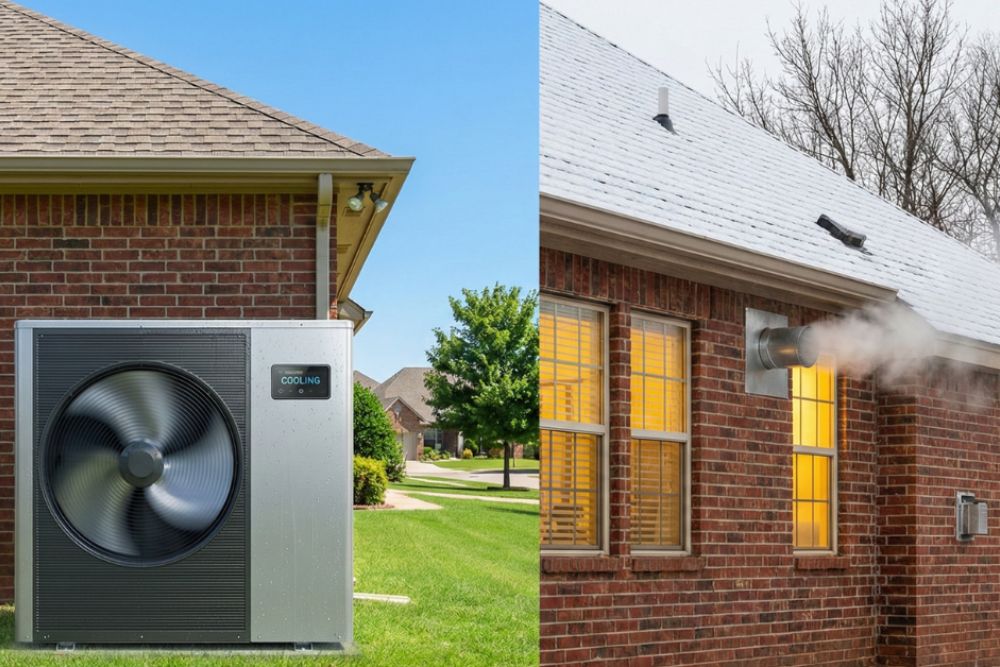
Oklahoma sits between these zones, with four distinct seasons, relatively mild but occasionally severe winters, and summers that rank among the most demanding in the country for cooling equipment.
This guide gives you a complete, honest comparison of heat pumps and gas furnaces across every dimension that matters for an Oklahoma homeowner: upfront cost, operating cost, efficiency, lifespan, comfort, and performance in Oklahoma’s specific climate. By the end, you will have a clear framework for making the right decision for your home.
How a Gas Furnace Works
A gas furnace generates heat through combustion. Natural gas burns in a sealed combustion chamber, heating a metal heat exchanger. Your system’s blower pulls air from your home across that heat exchanger, warming it before distributing it through your ductwork. Combustion exhaust is vented out through a flue pipe.
Gas furnace efficiency is measured by its Annual Fuel Utilization Efficiency (AFUE) rating. A 96 AFUE furnace converts 96 percent of the fuel it burns into usable heat. The remaining 4 percent is lost through exhaust. Modern high-efficiency condensing furnaces achieve 95 to 98 AFUE, while standard efficiency models run 80 to 82 AFUE.
Gas furnaces produce supply air temperatures at the vents of roughly 120 to 140 degrees Fahrenheit, which most people experience as immediately warm and satisfying. The system runs in discrete cycles, bringing the home to the thermostat set point before shutting off until the temperature drops again.
How a Heat Pump Works
A heat pump does not generate heat. Instead, it moves heat from one location to another using electricity and refrigerant. In summer, it operates exactly like a central air conditioner, removing heat from inside your home and releasing it outdoors. In winter, it reverses the process: extracting heat energy from the outdoor air and moving it into your home.
This surprises many people: outdoor air contains usable heat energy even at temperatures well below freezing. Modern cold-climate heat pumps can extract heat efficiently at outdoor temperatures as low as zero degrees Fahrenheit or below. This is what makes heat pumps capable of efficiencies that appear impossibly high compared to any combustion-based system.
Heat pump efficiency is measured by the Coefficient of Performance (COP). A heat pump with a COP of 3.0 delivers 3 units of heat energy for every 1 unit of electricity consumed. That is equivalent to 300 percent efficiency, something no gas furnace can match under normal operating conditions. At moderate temperatures around 40 to 50 degrees Fahrenheit, which describes much of Oklahoma’s fall and spring, modern heat pumps routinely achieve COP values of 3.0 to 4.5.
Efficiency Context:
Even at 5 degrees Fahrenheit, modern cold-climate heat pumps deliver roughly 1.9 units of heat per unit of electricity consumed, based on field data from the Pacific Northwest National Laboratory. A 96% AFUE gas furnace delivers 0.96 units of heat per unit of gas burned. The heat pump remains roughly twice as efficient in energy conversion even in serious cold, though local fuel price differences affect which system is actually cheaper to run in your market.
Oklahoma’s Climate and Why It Matters for This Decision
Oklahoma sits in a climate zone that makes heat pump performance genuinely attractive. The state experiences four distinct seasons, and according to the Oklahoma Climatological Survey, Oklahoma winters are shorter and less severe than those of the more northern plains states. Periods of extreme cold are infrequent, and those lasting more than a few days are relatively rare.
Northeast Oklahoma, including Claremore and the Tulsa metro area, averages approximately 3,500 to 4,000 heating degree days annually and fewer than 20 days per year with overnight lows below 20 degrees Fahrenheit. This profile is significant because heat pump performance declines at lower outdoor temperatures, and Oklahoma’s winters spend most of their time in the range where heat pumps operate at or near peak efficiency.
The primary performance concern for Oklahoma homeowners is the occasional severe cold snap, most notably the February 2021 winter storm that brought sustained temperatures below 10 degrees Fahrenheit across the state for several days. A standard heat pump without backup heat would have struggled during that event. A cold-climate heat pump or a dual-fuel system with gas furnace backup handles exactly this scenario reliably.
Upfront Cost Comparison: What Each System Costs to Install in Oklahoma
Here is how upfront installation costs compare for typical Oklahoma residential installations in 2025:
| System Type | Equipment Plus Labor (Typical Range) | Key Note |
| Standard Gas Furnace (80 AFUE) | $2,800 to $5,500 | Heating only. Separate AC required. |
| High-Efficiency Furnace (96 AFUE) | $3,500 to $7,000 | Heating only. Separate AC required. |
| Standard Heat Pump (16-17 SEER2) | $4,500 to $7,500 | Heats AND cools. No separate AC needed. |
| High-Efficiency Heat Pump (18-20 SEER2) | $6,500 to $10,000 | Heats AND cools. No separate AC needed. |
| Cold-Climate Heat Pump | $7,500 to $12,000 | Best for OK winters. Heats AND cools. |
| Dual-Fuel Hybrid System | $7,000 to $13,000 | Heat pump plus gas backup. Optimal for OK. |
The critical context that changes the math: A gas furnace only heats. If you are replacing an aging furnace and your AC is also old, comparing furnace costs to heat pump costs without accounting for the AC side produces an incomplete and misleading comparison. A heat pump replaces both systems in one installation. When you add the $4,500 to $9,500 cost of a new central AC to the furnace price, a heat pump often comes out ahead or equal on total installed cost for a complete heating and cooling upgrade.
Federal Tax Credit Alert:
Under the Inflation Reduction Act, qualifying heat pump installations are eligible for a federal tax credit of up to $2,000 per year. Gas furnaces qualify for a smaller credit of up to $600. This difference alone can narrow or eliminate the upfront cost gap between the two systems. Confirm eligibility with your tax advisor and ask your contractor to verify the proposed system meets the qualifying efficiency thresholds.
Operating Cost: Which System Costs Less to Run in Oklahoma?
Operating cost depends on three interacting variables: equipment efficiency, local fuel prices, and how cold your winters get. Here is how these variables play out in Oklahoma’s specific market.
The Efficiency Advantage
A high-efficiency gas furnace with a 96 AFUE rating converts 96 percent of the gas it burns into usable heat. A comparable heat pump operating at 40 degrees Fahrenheit achieves a COP of roughly 3.0 to 3.5, meaning it delivers 300 to 350 percent efficiency. Even at 20 degrees Fahrenheit, a cold-climate heat pump achieves a COP around 2.0 to 2.5, still significantly more efficient than combustion in terms of energy conversion per dollar spent.
Oklahoma Fuel Prices
Oklahoma has relatively low natural gas prices compared to the national average, which has historically favored gas furnaces on a monthly operating cost basis despite the efficiency disadvantage. However, electricity prices through OG&E and PSO are also competitive, and the heat pump’s efficiency advantage often overcomes the fuel price difference entirely, particularly during the fall and spring shoulder seasons when temperatures are moderate and heat pump efficiency is at its peak.
Research from Zero Homes indicates the average annual operating cost savings for switching from a gas furnace to a heat pump is approximately $650 per year for a 1,800-square-foot home with modern insulation. Regional HVAC research specific to Oklahoma’s climate suggests savings in the range of 20 to 40 percent on total heating and cooling costs when replacing a gas furnace and AC with a heat pump system.
Year-Round Savings
Oklahoma homeowners who install a heat pump benefit from efficiency gains in summer as well as winter, because the heat pump replaces the AC entirely. A high-efficiency heat pump with a SEER2 rating of 18 or higher reduces summer cooling costs compared to an older or entry-level AC unit, adding to the total annual savings picture beyond just the heating season comparison.
Side-by-Side Comparison: Heat Pump vs. Gas Furnace for Oklahoma Homes
| Heat Pump | Gas Furnace |
| Heats AND cools in one system | Heats only. Separate AC required. |
| 2x to 4x more efficient in energy conversion | Up to 96% efficient at converting fuel to heat |
| 20 to 40% lower annual energy costs in Oklahoma’s climate | Competitive cost when natural gas prices are low |
| Up to $2,000 federal tax credit (IRA) | Up to $600 federal tax credit (IRA) |
| Typical lifespan: 12 to 15 years | Typical lifespan: 15 to 20 years |
| Higher upfront cost, but replaces AC too | Lower upfront cost for heating-only replacement |
| Cold-climate models effective to 0 degrees F and below | Full heating output at any outdoor temperature |
| No on-site combustion, no CO risk | Requires proper venting and CO detectors |
| Lower carbon footprint (no fuel combustion) | Burns natural gas or propane on-site |
| Steady, continuous airflow delivery | Intermittent high-temperature air bursts |
| Better indoor humidity management in winter | Can dry indoor air; whole-house humidifier may be needed |
The Dual-Fuel Option: Often the Best Choice for Oklahoma Homes
For Oklahoma homeowners who want the efficiency advantages of a heat pump during moderate temperatures but are concerned about performance during the state’s occasional severe cold snaps, a dual-fuel hybrid system is often the optimal solution.
A dual-fuel system pairs an electric heat pump with a gas furnace backup. During fall, spring, and the milder parts of winter, the heat pump handles all heating at maximum efficiency. When outdoor temperatures drop below a programmable balance point, typically 25 to 35 degrees Fahrenheit, the system automatically switches to the gas furnace, which provides reliable, powerful heat during the coldest days.
This configuration captures heat pump efficiency across the majority of Oklahoma’s heating season, which spends most of its time in the moderate temperature range, while preserving gas furnace reliability for the rare extreme cold events. The additional upfront cost of a dual-fuel system over a standard heat pump installation is typically $1,000 to $3,000, which is well-justified by the performance and peace of mind it delivers to most northeast Oklahoma homeowners.
Oklahoma-Specific Note:
The February 2021 winter storm that brought sustained temperatures below 10 degrees Fahrenheit to much of northeast Oklahoma for several consecutive days is a compelling argument for cold-climate heat pump models or a dual-fuel hybrid configuration. Standard heat pumps without cold-climate ratings would have struggled during that event. Cold-climate heat pumps and dual-fuel systems are specifically designed for exactly this type of scenario.
When a Heat Pump Is the Right Choice for Your Oklahoma Home
- You are replacing both your AC and furnace at the same time and want to simplify to one efficient system
- Your home is well-insulated and air-sealed, which maximizes heat pump performance during cold periods
- You want to maximize the available federal tax credit of up to $2,000 for heat pumps versus $600 for furnaces
- You do not have natural gas service and your current heating is propane or electric resistance
- You are building a new home where infrastructure is not yet established
- You prefer lower carbon emissions and a path toward full home electrification
When a Gas Furnace Is the Right Choice for Your Oklahoma Home
- Your existing furnace is the only system being replaced and your AC was recently installed and is in good condition
- Your home has natural gas service and a functioning duct system already designed for furnace operation
- Your budget limits your upfront investment and you need the lowest possible initial cost for heating alone
- You strongly prefer the high-temperature supply air that furnaces deliver during cold weather
- Your home has characteristics that reduce heat pump effectiveness, such as poor insulation throughout or very large unconditioned spaces
Lifespan, Maintenance, and What to Expect Over Time
A well-maintained gas furnace in Oklahoma typically delivers 15 to 20 years of service. A heat pump system typically lasts 12 to 15 years. The shorter heat pump lifespan reflects the fact that the system runs year-round providing both heating and cooling, while a furnace only operates during the heating season.
Both systems benefit significantly from annual professional maintenance. For a furnace, the critical fall service should include burner cleaning, heat exchanger inspection, igniter and flame sensor testing, and gas pressure verification. For a heat pump, service is best performed twice annually, once in spring before cooling season and once in fall before heating season, to address both operational modes.
Rescue Heat and Air provides professional heating maintenance services for both furnaces and heat pumps across Claremore, Tulsa, and all of northeast Oklahoma. Our NATE-certified technicians are trained on both system types and can advise on the right service schedule for your specific equipment.
Comfort Differences: What Each System Feels Like Day to Day
Supply Air Temperature
Gas furnaces deliver air at 120 to 140 degrees Fahrenheit from the vents, which most people find immediately warm and satisfying. Heat pumps typically deliver air at 90 to 100 degrees Fahrenheit, which is effective at heating but can feel less dramatic. Variable-speed heat pumps run more continuously at lower output levels, maintaining a steadier indoor temperature without the large swings of a single-stage furnace.
Humidity Management
Gas furnaces burn fuel to generate heat, and the combustion process reduces indoor relative humidity. During Oklahoma winters, when the air is already relatively dry, a furnace can leave indoor air uncomfortably dry without a whole-house humidifier. Heat pumps do not combust fuel and better maintain balanced indoor humidity levels, which many homeowners find more comfortable and which reduces respiratory irritation, static electricity, and wood shrinkage in furniture and flooring.
Indoor Air Quality and Safety
A properly installed and maintained gas furnace poses no indoor air quality risk under normal operation. However, a cracked heat exchanger or blocked flue can allow combustion gases, including carbon monoxide, to enter the home. Heat pumps involve no combustion and eliminate this specific risk category entirely. For homeowners with particular air quality concerns or households with medically sensitive occupants, this difference carries meaningful weight.
Not Sure Which System Is Right for Your Oklahoma Home?
Rescue Heat and Air helps Claremore, Tulsa, Broken Arrow, Owasso, and northeast Oklahoma homeowners make confident, informed heating and cooling decisions. Our NATE-certified technicians assess your home, your existing infrastructure, and your priorities to recommend the right system honestly and without pressure. Call us today for a free consultation.
Questions to Ask Your HVAC Contractor Before Deciding
- Does my home’s insulation and air sealing support effective heat pump operation during Oklahoma winters?
- If I choose a heat pump, do you recommend a standard model, a cold-climate model, or a dual-fuel hybrid for this area?
- What SEER2 and HSPF2 ratings does the proposed heat pump carry, and does it qualify for the full $2,000 federal tax credit?
- Is my electrical panel adequate for a heat pump installation, or will an upgrade be required?
- If I choose a furnace, what AFUE rating does the proposed system carry and what is the expected annual operating cost compared to a heat pump in my situation?
- What warranties apply to both the equipment and your labor, and what maintenance schedule does the manufacturer require to maintain coverage?
Final Thoughts: Making the Right Decision for Your Oklahoma Home
The heat pump versus furnace debate does not have one universal right answer, but for most Oklahoma homeowners replacing aging equipment in 2025, the heat pump or dual-fuel hybrid system offers compelling advantages in efficiency, operating cost, and the ability to address both heating and cooling needs in a single installation.
Homeowners with existing gas infrastructure, a recently replaced AC, and a limited upfront budget may find a high-efficiency gas furnace replacement to be the more practical near-term choice. Homeowners doing a complete system upgrade, building new, or wanting to maximize long-term energy savings and federal incentive benefits should give a heat pump or dual-fuel hybrid serious consideration.
The most important step is talking with a technician who understands both systems and can assess your specific home, not one who defaults to whichever system the company installs most. Rescue Heat and Air works with both heat pumps and gas furnaces and provides honest recommendations based on your home’s actual conditions and your priorities.
For more on protecting your heating and cooling investment year-round, read our guides on common heating issues in fall and how to fix them, how to prep your AC for an Oklahoma summer, and AC installation cost in Oklahoma.
Schedule a Free System Consultation with Rescue Heat and Air
Our NATE-certified technicians serve Claremore, Tulsa, Broken Arrow, Owasso, Catoosa, Pryor, Collinsville, and all of northeast Oklahoma. We will assess your home, compare your options honestly, and help you choose the heating and cooling system that delivers the best performance and value for your specific situation.
Phone: 918-946-6681
Email: info@rescueheatandair.com
Schedule Online
Related Posts You May Find Helpful
These additional resources from Rescue Heat and Air cover topics that connect directly to the heat pump and furnace decision for Oklahoma homeowners.
- How Much Does AC Installation Cost in Oklahoma? (2025 Guide)
Since a heat pump replaces your AC as well as your furnace, understanding the full cost picture of a heat pump or AC installation in Oklahoma is essential. This guide breaks down costs by home size, efficiency rating, and system type with real Oklahoma price data. - How to Prep Your AC for a Hot Oklahoma Summer
If you choose a heat pump, it handles your cooling as well as your heating. This spring preparation guide applies directly to heat pump maintenance, covering the key tasks that protect system performance through Oklahoma’s demanding cooling season. - Common Heating Issues in Fall and How to Fix Them
Whether your current system is a furnace or a heat pump, fall is when heating problems reveal themselves. This guide covers the eight most common failures Oklahoma homeowners experience in October and November, with clear guidance on diagnosis and repair. - Heating System Installation in Claremore, OK
Ready to move forward with a new heating system? This page covers the full scope of Rescue Heat and Air heating installations across Claremore and northeast Oklahoma, including what the process looks like from assessment through commissioning. - HVAC Financing Options in Oklahoma
A heat pump or dual-fuel hybrid system represents a meaningful upfront investment. This page covers the flexible financing programs available through Rescue Heat and Air that make a complete system upgrade accessible without requiring full payment at installation.