Quick Answer:
The most common cause of a furnace blowing cold air is a clogged air filter that overheats the system and trips the high-limit safety switch, which shuts off the burners but leaves the blower fan running. Other frequent causes include the thermostat fan set to “On” instead of “Auto,” a thermostat set to “Cool,” an extinguished pilot light or failed igniter, a dirty flame sensor, or a blocked condensate drain on high-efficiency models.
A brief 1 to 2 minute burst of cool air when the furnace first starts is completely normal. If cold air continues beyond that, work through the checklist below in order, starting with the thermostat and filter before assuming you need a technician.
Few things derail a cold Oklahoma evening faster than reaching for warmth and getting a blast of cold air instead. Before you assume the worst, know that the majority of furnace blowing cold air complaints trace back to one of a small handful of causes, and several of them you can check and fix yourself in under ten minutes.
This guide is built as a diagnostic sequence, not just a list of possible problems. Work through it in order, starting with the fastest and easiest checks, and you will identify the cause far faster than searching through an alphabetical list of every possible furnace fault.
Table of Contents
- Step 1: Rule Out Normal Startup Behavior First
- Step 2: Check Your Thermostat Settings (Takes 30 Seconds)
- Step 3: Check and Replace Your Air Filter
- Step 4: Check for an Extinguished Pilot Light or Ignition Failure
- Step 5: Suspect a Dirty or Failing Flame Sensor
- When Electric Is Genuinely the Better Choice in Oklahoma
- Step 6: Check for a Tripped Breaker or Blown Fuse
- Step 7: Check the Condensate Drain on High-Efficiency Furnaces
- Step 8: Rule Out Duct and Airflow Problems
- Diagnostic Summary Table: Match Your Symptom to the Likely Cause
- When a Cold-Air Complaint Signals a Bigger Problem
- Final Thoughts
- Frequently Asked Questions
- Related Posts You May Find Helpful
Step 1: Rule Out Normal Startup Behavior First
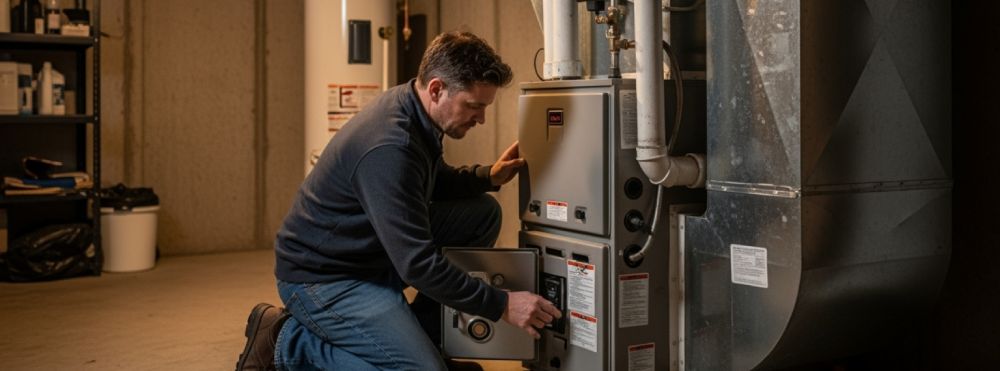
When a furnace has been off for a while, the air sitting in your ductwork is cold. It takes the system a short warm-up period, typically 1 to 2 minutes for older furnaces with a pilot light delay, or even less for modern ignition systems, before the air coming from your vents reaches a comfortable temperature. If you just turned the heat on and felt a cool draft for the first minute or two, that is normal operation, not a malfunction. Give it a few minutes before moving to the next step.
Step 2: Check Your Thermostat Settings (Takes 30 Seconds)
This sounds almost too obvious to mention, but it resolves a surprising share of cold air complaints, and it costs nothing to check.
- Confirm the mode is set to HEAT, not COOL. If someone in the house bumped the mode dial or a smart thermostat schedule reverted unexpectedly, the system will run the blower without calling for heat.
- Confirm the fan setting is AUTO, not ON. When set to ON, the blower fan runs continuously, including the minutes between heating cycles when no warm air is being produced. This circulates room-temperature or cool air through your vents and feels exactly like a furnace blowing cold air, even though the furnace itself is working correctly.
- Confirm the set temperature is above the current room temperature. A thermostat set lower than the room’s actual temperature will not call for heat at all.
- Replace the batteries if your thermostat uses them. A thermostat with weak batteries can misread temperature or fail to communicate properly with the furnace, leading to erratic cycling.
Step 3: Check and Replace Your Air Filter
A clogged filter is the single most common cause of a furnace blowing cold air, and it is a problem you can usually see with your own eyes. Here is exactly how this failure happens, since understanding the mechanism helps you recognize it again in the future:
- Dust and debris accumulate on the filter, restricting airflow into the furnace
- With less air moving across the heat exchanger, the metal heats up faster than it should
- Internal temperature climbs past the safety threshold
- The high-limit switch, a safety device, shuts off the burners to prevent overheating or fire risk
- The blower fan keeps running to cool the unit down, pushing room-temperature or cold air through your vents the entire time
Pull the filter and hold it up to a light. If you cannot see light passing through it, or if it is visibly gray, brown, or matted with dust and pet hair, replace it immediately. This single fix resolves cold-air complaints more often than every other cause combined. For full guidance on filter types and replacement schedules, see our HVAC Filter Guide.
Why This Matters in Oklahoma:
Northeast Oklahoma’s dusty fall conditions and high pollen seasons load filters faster than in many other regions. A filter that looked fine in August may already be clogged by the time the first cold front arrives in October or November, which is exactly why this is the most common cold-air call HVAC companies in Claremore and Tulsa receive each fall.
Step 4: Check for an Extinguished Pilot Light or Ignition Failure
If your furnace is older and still uses a standing pilot light, look through the small viewing window on the furnace cabinet. The flame should burn steady and blue. A flame that is yellow, flickering, or absent entirely indicates a problem.
- Pilot light is out: Most manufacturers print relighting instructions on a label inside the furnace access panel. Follow them exactly. If the pilot will not stay lit after relighting, the thermocouple, a small safety sensor that detects the pilot flame, is likely failing and needs professional replacement.
- Modern furnaces (built since roughly 2010) use electronic ignition instead of a pilot light. These systems use either a hot surface igniter or an intermittent spark igniter. A failed igniter will not produce any flame at all, and the furnace will attempt ignition, fail, and lock out after a few tries. This requires professional replacement and is not a DIY repair.
Step 5: Suspect a Dirty or Failing Flame Sensor
This is the cause that catches the most homeowners off guard, because the symptoms look identical to a filter problem but the filter is perfectly clean. The flame sensor is a small metal rod near the burner that confirms a flame is actually present after ignition. If the sensor is coated with carbon buildup or oxidation, even from normal operation over a season or two, it stops reliably detecting the flame.
When this happens, the furnace ignites normally, runs briefly, and then shuts down because the control board believes (incorrectly) that there is no flame present, since the sensor cannot confirm it. The blower may continue running, delivering cold air, while the burner repeatedly attempts and aborts ignition in the background. Cleaning a flame sensor with a fine abrasive pad is a routine, low-cost repair for a technician and is one of the most common fixes during a service call for this exact complaint.
Step 6: Check for a Tripped Breaker or Blown Fuse
Furnaces typically run on a dedicated circuit. If that breaker trips, certain furnace control boards can leave the blower running on a separate circuit while the burner circuit is dead, again producing the cold-air-only symptom. Check your electrical panel for a tripped breaker on the furnace circuit and reset it once. If it trips again immediately, do not keep resetting it. A breaker that trips repeatedly indicates an electrical fault that needs professional diagnosis rather than repeated resets, which can pose a fire risk.
Step 7: Check the Condensate Drain on High-Efficiency Furnaces
If your furnace is a high-efficiency condensing model (look for white PVC venting pipes rather than a metal flue), it produces condensate water as a byproduct of combustion, and that water must drain properly. A clogged condensate line triggers a safety float switch that shuts down the burner entirely while often leaving the blower running, producing the same cold-air symptom as the other causes above.
Locate the condensate drain line, usually a PVC pipe running from the furnace to a floor drain or condensate pump. Check for visible water pooling near the unit, which is the telltale sign. Clearing this blockage is a moderately involved DIY task for a confident homeowner, but many people prefer to have a technician handle it given the proximity to electrical and combustion components.
Step 8: Rule Out Duct and Airflow Problems
Less commonly, the furnace itself works correctly but the air feels cooler than expected by the time it reaches your living space. This usually points to a ductwork issue rather than a furnace malfunction:
- Leaky ductwork in an unconditioned attic or crawlspace: Warm air mixes with cold attic or crawlspace air through gaps and seams before reaching your vents, lowering the delivered temperature.
- Closed or blocked supply registers: Furniture, rugs, or curtains blocking vents restrict airflow and can make remaining airflow feel weaker and cooler at distant rooms.
- Undersized or poorly designed ductwork: In some older homes, the duct system was never properly sized for the heating load, leading to consistently lukewarm air at the far ends of the house regardless of furnace condition.
Diagnostic Summary Table: Match Your Symptom to the Likely Cause
| What You Notice | Most Likely Cause | DIY or Pro? |
| Cold air only for the first 1-2 minutes | Normal startup behavior | No action needed |
| Constant cool air, furnace runs all the time | Fan set to “ON” instead of “AUTO” | DIY |
| No heat at all, fan runs continuously | Clogged air filter triggering limit switch | DIY |
| No flame visible in viewing window | Pilot light out or failed thermocouple | DIY to relight; Pro if it won’t stay lit |
| Furnace ignites briefly then shuts off, repeats | Dirty or failing flame sensor | Pro |
| Furnace won’t start at all, no sound | Tripped breaker or electrical fault | DIY (reset once); Pro if it trips again |
| Water pooling near furnace, no heat | Clogged condensate drain (high-efficiency models) | DIY or Pro |
| Heat works but specific rooms stay cool | Duct leaks or blocked vents | DIY (check vents); Pro for duct sealing |
Worked Through the Checklist and Still No Heat?
If you have checked your thermostat, filter, and breaker and your furnace is still blowing cold air, the issue is likely a component that requires professional diagnosis: a failed igniter, dirty flame sensor, faulty limit switch, or gas supply issue. Rescue Heat and Air offers fast, honest furnace repair across Claremore, Tulsa, Broken Arrow, Owasso, and northeast Oklahoma. We diagnose the actual cause rather than guessing, and we explain exactly what we find before any repair begins.
When a Cold-Air Complaint Signals a Bigger Problem
Most causes covered above are routine and inexpensive to fix. A few warrant extra caution:
- Repeated breaker trips: Indicates a developing electrical fault. Stop resetting the breaker and call for service.
- A burning or unusual smell along with cold air: Could indicate an overheating motor or electrical component. Turn the system off and call a technician.
- Yellow, flickering flame visible through the viewing window: Can indicate incomplete combustion and a possible carbon monoxide risk. This needs professional attention promptly, and you should confirm your carbon monoxide detectors are working in the meantime.
- The furnace is more than 15 years old and this is a recurring issue: Repeated cold-air complaints on an aging system often signal the heat exchanger or control board is nearing the end of its service life. A repair-versus-replace conversation with a technician makes sense at this point.
Final Thoughts
A furnace blowing cold air is almost always traceable to one of the causes above, and the majority resolve with a thermostat adjustment or a fresh filter. Work through the checklist in order, starting with the fastest checks, and you will either solve the problem yourself or arrive at a technician’s door with useful information that speeds up diagnosis and saves you money on the service call.
For broader seasonal preparation that prevents many of these issues before they start, see our Fall HVAC Maintenance Checklist for Oklahoma, and if your furnace cycles on and off rapidly rather than blowing steady cold air, that is a related but distinct issue covered in our guide on furnace short cycling.
Frequently Asked Questions
Is it normal for a furnace to blow cold air for a few minutes?
Yes. A brief cool-air period of 1 to 2 minutes at startup is normal, especially on cold starts after the system has been off for a while. The ductwork itself is cold and needs a moment to warm up. If cold air continues beyond a few minutes, work through the troubleshooting steps above.
Why does my furnace run but never get warm?
This pattern most often points to a clogged air filter triggering the high-limit safety switch, which shuts off the burner while the blower fan keeps running. It can also indicate a failing flame sensor that is causing the burner to shut down shortly after ignition. Check the filter first, since it is the fastest and most common fix.
Can a dirty flame sensor really stop my furnace from heating?
Yes. The flame sensor confirms to the control board that the burner has successfully ignited. If carbon buildup prevents it from detecting the flame, even though the flame is actually present, the control board shuts the burner down as a safety precaution, leaving you with a blower that runs but no heat.
Should I keep resetting the breaker if my furnace won’t start?
No. Reset a tripped breaker once. If it trips again immediately, stop and call for professional service. A breaker that repeatedly trips indicates an electrical fault, and continuing to reset it risks further damage to components or, in rare cases, a fire hazard.
How do I know if my furnace filter is the problem?
Pull the filter out and hold it up to a light source. If you cannot see light passing through cleanly, or the filter looks gray, brown, or matted, it needs replacement. This is the single most common cause of a furnace blowing cold air and the easiest one to rule out yourself.
Why is only one room in my house getting cold air while others are warm?
This points to a ductwork issue rather than a furnace problem, most commonly a closed or blocked register, a duct leak in that specific run, or an undersized duct branch serving that room. A whole-furnace fix will not solve a single-room airflow problem; the duct system to that room needs to be inspected.
Related Posts You May Find Helpful
These resources from Rescue Heat and Air cover related furnace issues Oklahoma homeowners commonly face.
- Furnace Short Cycling: Causes & Fixes
If your furnace is turning on and off rapidly rather than blowing steady cold air, that is short cycling, a related but distinct problem with its own set of causes and fixes covered in detail here. - Common Heating Issues in Fall and How to Fix Them
A furnace blowing cold air is one of eight common fall heating problems covered in this comprehensive guide for Oklahoma homeowners, with guidance on diagnosis and repair for each. - HVAC Filter Guide: Types, Ratings & How Often to Change
Since a clogged filter is the most common cause of cold air complaints, this complete guide helps you choose the right filter and build a replacement schedule that prevents the problem from recurring. - How Long Does an HVAC Repair Take?
If your cold-air issue turns out to need a professional repair, this guide tells you realistically how long common furnace repairs take, from a quick flame sensor cleaning to a more involved igniter replacement. - Fall HVAC Maintenance Checklist for Oklahoma
A thorough fall tune-up catches a failing flame sensor, dirty filter, or ignition issue before it leaves you without heat on a cold night. This checklist covers everything to do before winter arrives.